Introduction
When using Large Language Model (LLM) APIs, many users encounter a common question: why is the cost higher than expected even when they only make a limited number of requests?
The reason is not always the number of API calls. Actual costs can be affected by input Tokens, output Tokens, context length, and the pricing rules of the selected model.
If you are using AI coding tools, chat assistants, or automated AI workflows, understanding Token billing helps you estimate AI costs, choose appropriate models, and avoid unnecessary expenses.
This guide explains the logic behind AI Token pricing through transparent calculation examples and introduces practical methods for reducing AI costs.
1. What Is a Token? How Are Large Language Models Priced?
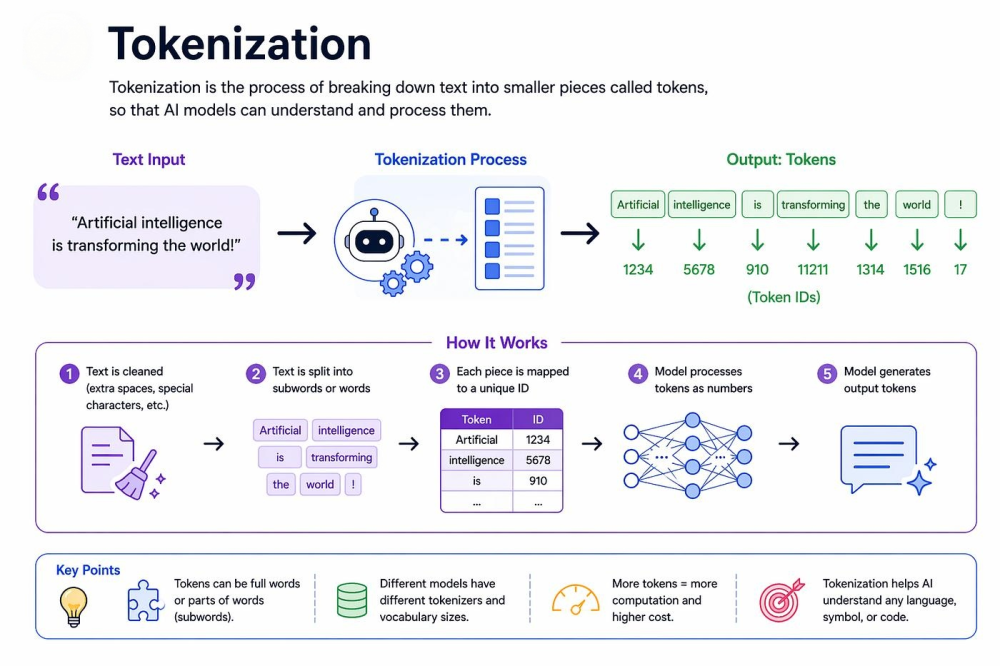
A Token is one of the basic units used by Large Language Models to process text. It does not represent exactly one Chinese character, one English word, or one character. Instead, Token counts are determined by the tokenizer rules used by each model.
For example, Chinese text, English text, programming code, and special symbols with similar lengths may generate different numbers of Tokens after tokenization.
Therefore, it is not accurate to assume that one Chinese character equals one Token, or that text length alone can precisely predict API costs.
In common LLM API pricing systems, users should pay attention to the following usage categories:
Input Tokens:The content sent to the model, including user questions, system instructions, conversation history, and other text included in the request.
Output Tokens:The content generated and returned by the model.
Cached Input Tokens:Input content that meets specific caching conditions. Some models may charge cached input at a different rate from standard input.
Reasoning Tokens or Other Special Usage:Some reasoning models may generate additional internal processing usage. Whether this usage is billed separately depends on the specific model provider.
Tool calls, multimodal inputs, images, audio, and video may use different Token calculation methods or additional billing rules.
Therefore, accurate AI cost estimation should begin with reviewing actual usage records and model pricing, rather than simply counting API requests.
2. How Are Input and Output Tokens Calculated?
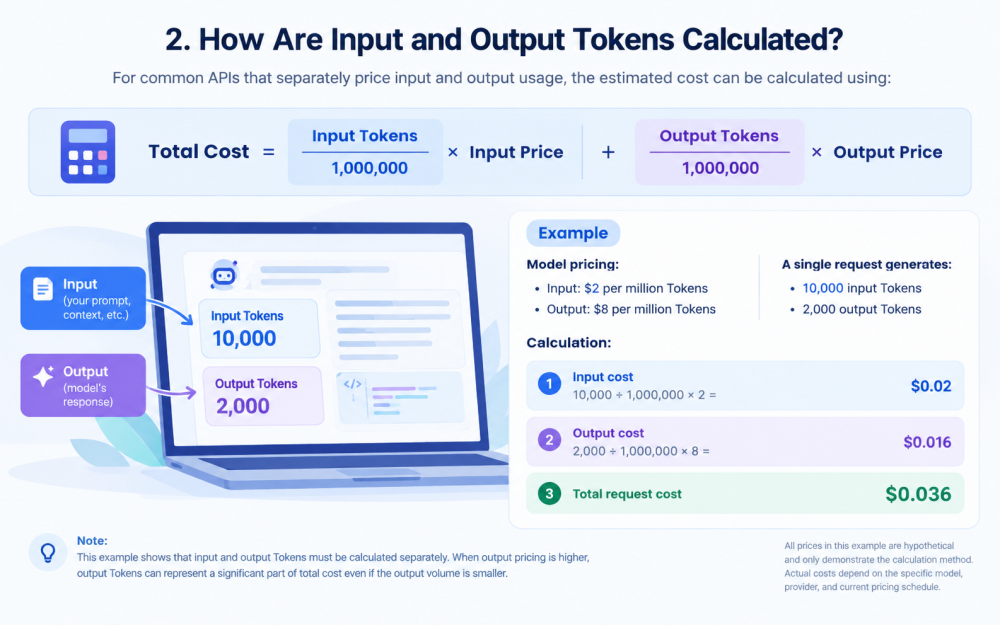
For common APIs that separately price input and output usage, the estimated cost can be calculated using:
Total Cost = Input Tokens ÷ 1,000,000 × Input Price + Output Tokens ÷ 1,000,000 × Output Price
The prices below are examples based on cost per one million Tokens.
If a model includes caching, image processing, audio processing, or other chargeable features, these costs should be calculated separately.
Example:
Assume a model has the following pricing:
Input: $2 per million TokensOutput: $8 per million Tokens
A single request generates:
10,000 input Tokens2,000 output Tokens
Calculation:
Input cost = 10,000 ÷ 1,000,000 × 2 = $0.02
Output cost = 2,000 ÷ 1,000,000 × 8 = $0.016
Total request cost = $0.036
This example shows that input and output Tokens must be calculated separately. When output pricing is higher, output Tokens can represent a significant part of total cost even if the output volume is smaller.
All prices in this example are hypothetical and only demonstrate the calculation method. Actual costs depend on the specific model, provider, and current pricing schedule.
3. Cost Calculation Example: Why Can the Same Number of Requests Have Different Costs?
Assume a developer uses an LLM API to generate technical articles. The developer sends 100 requests per day, and each request contains task instructions and related context.
For comparison, assume:
Input price: $2 per million TokensOutput price: $8 per million Tokens
Caching, taxes, and additional fees are not included.
Scenario A: Shorter Input Context
Each request contains:2,000 input Tokens1,000 output Tokens
Daily input:100 × 2,000 = 200,000 Tokens
Daily output:100 × 1,000 = 100,000 Tokens
Cost:
Input:200,000 ÷ 1,000,000 × 2 = $0.40
Output:100,000 ÷ 1,000,000 × 8 = $0.80
Daily total:$1.20
Scenario B: Large Repeated Context
Each request contains:10,000 input Tokens1,000 output Tokens
Daily input:1,000,000 Tokens
Daily output:100,000 Tokens
Cost:
Input:1,000,000 ÷ 1,000,000 × 2 = $2.00
Output:100,000 ÷ 1,000,000 × 8 = $0.80
Daily total:$2.80
The number of requests is identical and the output volume is unchanged, but the daily cost increases from $1.20 to $2.80, an increase of approximately 133.3%.
This example demonstrates that repeatedly sending long system instructions, conversation history, or reference materials can continuously increase input Token usage.
For AI workflows running hundreds or thousands of times per day, this difference can become even more significant.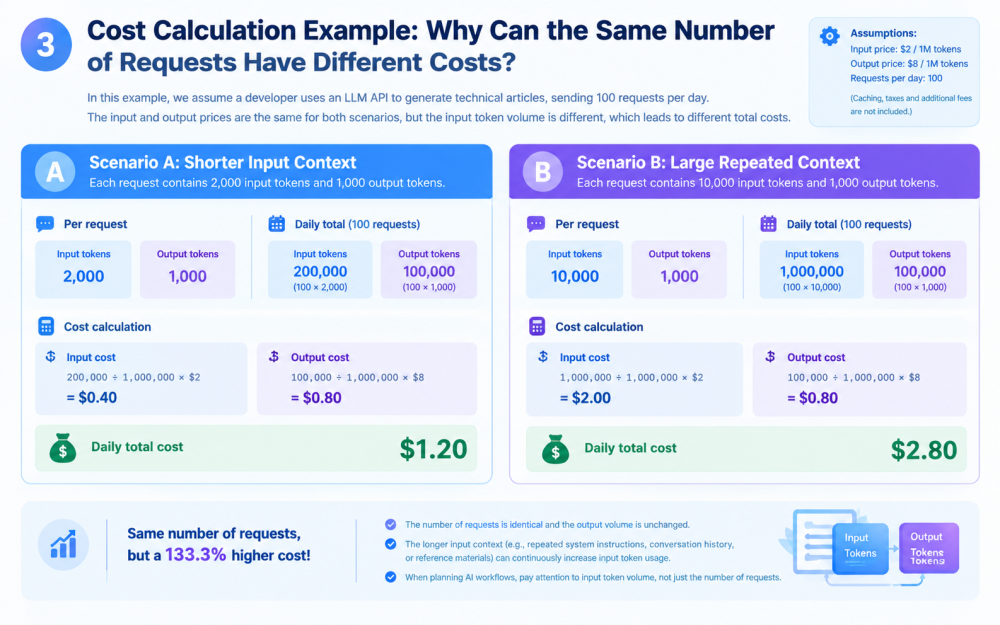
4. Five Common Misconceptions About AI Token Billing
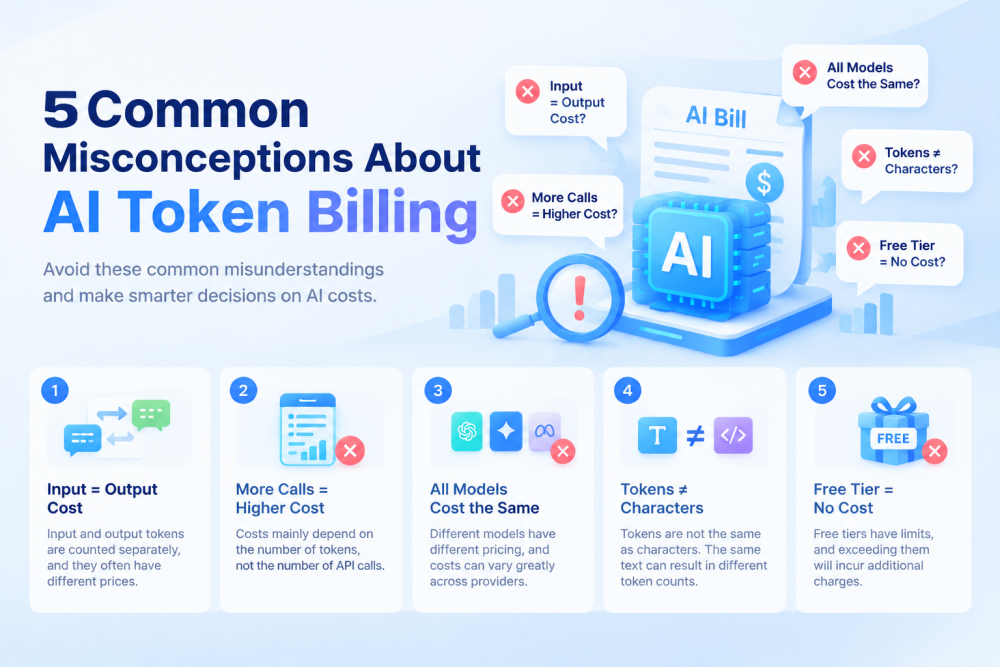
1. Only Looking at Input Pricing and Ignoring Output Pricing
Different models may have significant differences between input and output prices. Tasks such as writing, code generation, and long-form analysis may produce large outputs, making output pricing an important factor.
Model selection should consider total cost based on input volume, output volume, and quality requirements, rather than comparing only input prices.
2. Treating Request Count as Actual Usage
One request may contain only a few dozen Tokens or may include tens of thousands of Tokens of context.
Request count only shows frequency. It does not directly represent cost.
A better approach is tracking input, output, and cached usage for each request and calculating total consumption.
3. Assuming All Models Count Tokens the Same Way
Different models may use different tokenization methods. The same text may produce different Token counts depending on the model.
For accurate estimation, use Token counting tools or usage records provided by the target model or service provider.
4. Assuming Shorter Prompts Always Reduce Costs
Prompt compression can reduce unnecessary content, but removing important instructions, context, or output requirements may reduce answer quality and cause additional retries.
Effective Prompt optimization is not simply reducing word count. It means removing unnecessary input while preserving essential information.
5. Ignoring Caching and Special Pricing Rules
Some models support Prompt Caching, allowing repeated input content to receive different pricing under certain conditions.
However, caching is not automatically applied to all repeated content. Users should verify eligibility and pricing rules.
Reasoning models, image inputs, and tool calls may also affect total costs. Always check official pricing documentation.
5. Five Practical Ways to Reduce AI Costs
Method 1: Track Token Usage for Every Request
Review API usage fields or provider dashboards to record input, output, and cached usage.
For content generation, customer service automation, or AI coding workflows, calculate average cost per task or conversation to identify expensive areas.
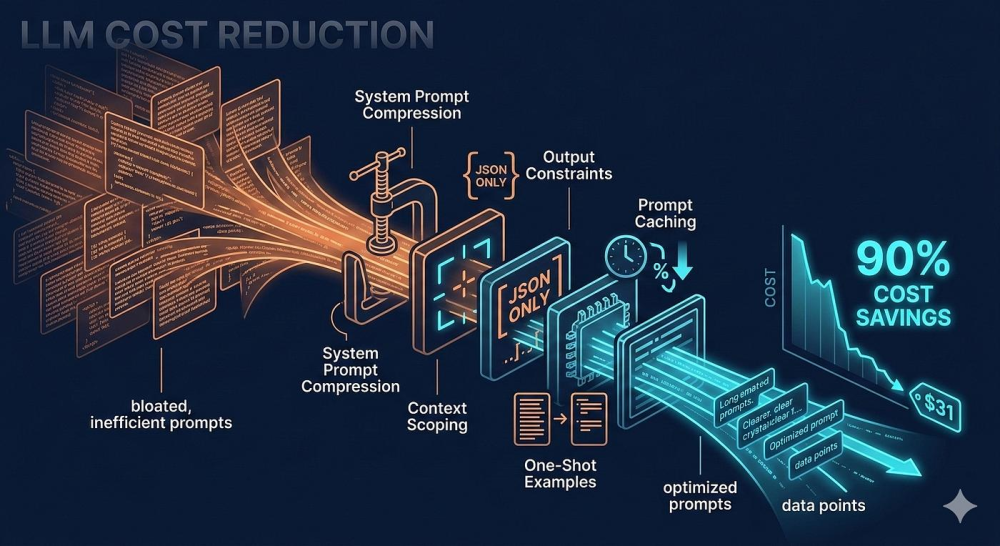
Method 2: Optimize Prompts
Remove repeated background information, irrelevant conversation history, and duplicated instructions.
Convert long-term stable requirements into concise and clear system prompts.
For long documents, consider providing only relevant sections, generating summaries first, or dividing large tasks into smaller tasks with clear inputs and outputs.
Always verify that optimization does not reduce result quality.
Method 3: Choose Models Based on Task Difficulty
Not every task requires the most expensive model.
Simple tasks such as classification, formatting conversion, and short text extraction may work well with lower-cost models.
Complex reasoning, debugging, and high-quality content creation require evaluating accuracy, reliability, and output cost together.
Method 4: Evaluate Prompt Caching
If an application repeatedly sends the same system instructions, rules, or reference materials, caching may reduce costs.
However, confirm model support, cache requirements, pricing rules, and whether actual usage patterns qualify.
Method 5: Set Budgets and Monitor Usage
Set appropriate budgets, usage alerts, and API limits.
If Token usage suddenly increases, investigate possible causes such as loops, growing context, uncontrolled output length, or automatic retries.
For team projects, separate usage data by model, application, or business task to understand cost sources.
6. What Else Should You Check When Choosing an AI API Service?
When comparing AI API providers, do not focus only on advertised prices.
Also check:
- Whether the actual available model matches the advertised model.- Whether input, output, and cached pricing are clearly explained.- Whether usage records can be reviewed.- Whether the service supports required API formats and model capabilities.- Whether privacy policies, data processing rules, and customer support are clearly provided.- Whether balance, limits, refunds, and service issue procedures are transparent.
For AI gateway or API aggregation services, understand which providers process requests, how data is handled, and whether the service provider has appropriate authorization or licensing.
API compatibility does not automatically mean identical model performance, service guarantees, or data handling practices.
Conclusion
Understanding AI Token billing comes down to three key questions:
How many input Tokens are used?How many output Tokens are generated?What pricing rules apply to each usage type?
By combining Prompt optimization, model selection, caching strategies, and usage monitoring, users can reduce AI costs more effectively.
For individuals and small teams, the goal should not simply be choosing the lowest unit price. A better approach is building transparent cost records and selecting models and API services based on actual usage, quality requirements, and business needs.
Need a more flexible way to manage AI usage costs?Explore AI Token solutions designed for developers, creators, and teams looking for better control over AI expenses.
View AI Token Plans → 

0 Comments